Of all the people I had the pleasure of meeting this trip, four stood out.
I had lunch with a couple in Greenland. A French Woman who used to be pretty high up with the WWF and a Danish Man who currently works for an oil company, preparing patents for maps of the ice fields in the Arctic.
Turns out the WWF used the Danish's Man's company info yearly to show and prove their point that the ice fields are shrinking at an alarming rate. And ironically diminishing ice means higher accessibility to off shore oil fields...
His company has high interest in Greenland's untapped resources. Even he had to admit when you compare the last 10 years of maps, it obviously pointed to non reversing shrinkage. In the March issue of Greenland Today, a significant amount of the magazine was dedicated to how Greenland will deal with all the worldwide companies wanting in on their resource development. And how their new government, elected a couple of days before I arrived will handle things.
Then the topic turned to travel. Whoa, did I feel like a small player compared to those two. The French Lady had been pretty much everywhere, couldn't speak more highly of Africa, especially Serengeti and Botswana and encouraged me to go there ASAP.
The Danish follow is an experienced trekker and his current favourite areas to hike were Annapurna (Nepal) and the Atlas Mountains (Morocco), having done Kilimanjaro twice and base camp Everest once and most of everywhere else you could think of. Their combined knowledge base of the world is downright stunning. Felt like I wasn't thinking big enough, that I lived a very sheltered life.
The third person was a young man from Switzerland. I remembered him from the departures area at Reykjavik airport, looking just spent. I found out later it was because he had gotten "Air Iceland" mixed up with "Icelandair". So he thought his flight to Greenland left from Keflavik...Which is at least an hour away...and he only had 1hr 45 min layover...
He spent his time couchsurfing with a local in Ilulisaat. Talked of how his host cooked whale -- Wrapped in bacon and in a slow cooker for the day -- Was unbelievably tender. He had a couple of great pictures of the Northern Lights. And was offered a job as a summer guide with the company I used. He too was disappointed that dogsledding was unavailable.
He was on the last leg of a 1 1/2 year backpacking adventure that took him to Asia and South America. His current favourite place was Kathmandu because of the locals. From Reykjavik, he was heading to the Faroe Islands, then Copenhagen, then hitchhiking all the way back home.
We spent the duration of the flight back to Reykjavik (3 hr) talking about his adventures. I told him how I longed for an extended period of time off (1 yr+) and how I cannot see how that could be possible without retiring completely, which I was not quite ready to do just yet. That I couldn't imagine even a month off whereas he cannot imagine taking a trip that was less than a month's duration.
He was ready to go home and start on his next phase of life, which will consist of further education as he wasn't interested in going back to his previous career. He encouraged me to go sooner than later (especially to China for the pollution is only getting worse) and to rent my house for the duration.
That after even a year, my thinking would change so much, nothing I was clinging to or worried about right now would really matter. Perception of obstacles will shrink. That's how much growth I would experience. It was his mindset and conviction I was most fascinated with.
Interestingly enough, he felt very strongly that keeping hold of a home base or core possessions was important. Without it, he would have high difficulty mentally, knowing he had nothing to come back to.
I had a difficult time understanding what he really meant by that as I see coming back to a clean slate incredibly exciting. A chance to create. If I was going house hunting right now, I would not chose the house we're living in because I've changed in the last 6 1/2 years we've been living here. The only thing holding me back is inertia, not wanting another mortgage or other related costs.
Last and certainly not least, our guide and superjeep driver in Reykjavik. He had some real interesting stories having been a commercial fisherman (tough job!) and as a driver for a high end private tour company.
His favourite celebrity was Roger Moore, described as incredibly polite, gracious and completely "Bond" all the way. Least favourite was Jude Law, whom he found to be very full of himself. He also had a chance to meet Kirsten Dunst (found her to be really shy) right after Spiderman 2 premiered as well as Angelina Jolie and her children.
This summer, he is taking a superjeep for a couple weeks to tour northern Iceland. He also listed a bunch of movies that were filmed in Iceland and confirmed that the beginning of the movie "Prometheus" was indeed Iceland!
When D and I went to see it (I had no idea it was the prequel to the Aliens franchise...otherwise I would have never gone...don't like anything that resembles horror), I leaned over and said to D, "That has to be Iceland! No other place on Earth looks like that...".
Icelanders, like the Norwegians, love their country and cannot wait till summer to explore it themselves. It's in their blood. Looking forward to the day I stand at Dettifoss myself. He told me the sound and power of it is unbelievable...I was ready to go right then and there...
***Forgot to mention in my last post that should you wish to do away with all the planning and gear that comes with cold weather travel, just go in the summer like what over 80% of visitors to Greenland do. You will have to bring some serious bug protection though ie. bug suit as I hear they are rampant and will eat you alive...Personally, I would take the cold over bug bites or bug suits any day but then again, I'm a mosquito magnet.***
Showing posts with label Greenland. Show all posts
Showing posts with label Greenland. Show all posts
Thursday, May 30, 2013


Friday, May 24, 2013
Travel Tips: Greenland & Iceland
People I met in Greenland thought it was really easy and convenient for me, a Canadian, to get there. If you look at a map, the west coast of Greenland is indeed much closer to Canada than Europe. They were appalled to hear I had to go to Reykjavik or Copenhagen first, just to fly back west again.
If you are determined to fly from Canada, (where it is often much more expensive to explore our own country than to go to Europe...) you will have to make your way to Ottawa (our Capital) during the summer months to catch a flight to Greenland for probably close to $2500+.
For some reason, I had it in my mind, it was only a short 1 hr 45 min flight to Ilulissat from Reykjavik (much cheaper to go from there by the way) on Air Iceland, when it was actually 4 hrs. When I realized my error, I felt instantly tired as it was going to be almost as long as the flight we take to go skiing out west. So I flew 5 hrs, to fly 4 hrs back.
Should you prefer to go via Copenhagen, you'll have to connect via Kangerlussuaq on Air Greenland. Connecting times can be less than 1 hour so make sure you have a Plan B. From what I've read and heard from a Danish Guy I met, it is quite common to be stranded there due to weather. That was my number one concern. I had a 4 day window post Greenland trip, just in case. Was lucky I didn't need it.
I don't think it will come as a complete surprise that the cost of living in remote places is much higher. One thing Greenlanders take very seriously is warmth -- Staying warm and shielding from wind. Their homes, as simple as they may appear, are built to withstand significant snow and wind loads. The gear and clothing you find there are serious, expensive and understandably so.
It made me so proud to see Canada Goose being one of the most prominent outfitters for the Greenlandic people. It also didn't surprise me that the big Norwegian brands -- Bergans of Norway (D's current favourite) and Dale of Norway (one of my favourites) were well represented. Made total sense to me.
Even though I experienced much warmer than usual temperatures during my visit, when you are out on the water, the wind and water temperature can make you very uncomfortable in a hurry. After all, you are sailing towards giant hunks and massive fields of ice.
A French Lady I met, after our first day on the water, showed up the second day clad in head to toe Canada Goose. Her jacket alone would have cost $800, much less the pants, hat and mittens. She had suffered a lot over the 5 hr out. Don't ever underestimate the power of wind nor the energy you expend trying to keep warm while standing mostly still on a small boat.
Here's what I wore for the days I was on the water where it was a handful of degrees below 0 C. Not at all cold by my standards and never would I dress like this at home. We ski and walk at -24 C before wind chill in altitude with less on than half of what I have listed below. After 5 hr, my core was comfortable but I was just starting to feel some coolness in the tips of my fingers, ears and elbow seams. My face felt cold but not enough to pull anything up over my nose.
Within the first minute of boat movement, you get to feel whether your preparations were sound. Cold wind will find its way into every open fold and non windproof seam. That's why I chose to wear a longer coat as well as ski pants that went higher than waist. There is nothing worse than a cold back. I'm sure the captain and crew were amused and probably used to seeing people quickly shuffling to adjust things like little marionettes.
Here's what I would do differently. I would spend more time playing around with the toggles of my coat hood to make sure they were even. There was a tiny stream of air that kept getting in between my hood and icebreaker hood (which was skin tight). Not enough to make me cold but the sound of it was irritating. I'd also spend more time adjusting the closure of my coat sleeves. Same idea. Ideally your gloves or mitts would go over the end of your sleeves.
I brought ski goggles (mainly for the dog sledding to shield from wind and potential flying dog poop...) but didn't use them. There were people who wore them on the ship but I just wore my sunglasses and they worked just fine. Wear sun block. The amount of sun/UV reflecting off of ice, snow and water is significant. I used a SPF 45 with zinc oxide, titanium dioxide and octinoxate and still managed to get some colour.
It's trickier taking pictures with ski mitts on but I managed. No way was I going to take them off for photos! If I had to, you wouldn't have seen any. Also, the cold will drain your camera battery much faster than you'd expect. I had more trouble starting up the camera as well.
Otherwise I was quite pleased with my selection of layers. I spent a lot of time experimenting with different combinations, especially when the weather warmed up prior to my departure. To the point where D wanted to forbid me from going on the trip because my scurrying around to re-pack was driving him crazy.
Here's what I would have done had the weather been "normal" for that time of year:
There were a few people I saw from warmer climates who had on what I consider to be slightly more padding than a spring jacket. They were allowed to go inside because they got so cold. I realize that real winter clothing may not be available to those from warmer countries. But they persevered and showed up the next day dressed the same, looking more apprehensive. And there was one guy who went all out and purchased a seal skin coat and pants. It was beautifully made. I later found out that the purchase would have cost him close to 12000 Euro!
You can imagine that no one really knew what each another looked like until we got rid of our layers. So it was like we were meeting one other for the first time when we finally had a chance to sit down for a meal after.
If you are determined to fly from Canada, (where it is often much more expensive to explore our own country than to go to Europe...) you will have to make your way to Ottawa (our Capital) during the summer months to catch a flight to Greenland for probably close to $2500+.
For some reason, I had it in my mind, it was only a short 1 hr 45 min flight to Ilulissat from Reykjavik (much cheaper to go from there by the way) on Air Iceland, when it was actually 4 hrs. When I realized my error, I felt instantly tired as it was going to be almost as long as the flight we take to go skiing out west. So I flew 5 hrs, to fly 4 hrs back.
Should you prefer to go via Copenhagen, you'll have to connect via Kangerlussuaq on Air Greenland. Connecting times can be less than 1 hour so make sure you have a Plan B. From what I've read and heard from a Danish Guy I met, it is quite common to be stranded there due to weather. That was my number one concern. I had a 4 day window post Greenland trip, just in case. Was lucky I didn't need it.
I don't think it will come as a complete surprise that the cost of living in remote places is much higher. One thing Greenlanders take very seriously is warmth -- Staying warm and shielding from wind. Their homes, as simple as they may appear, are built to withstand significant snow and wind loads. The gear and clothing you find there are serious, expensive and understandably so.
It made me so proud to see Canada Goose being one of the most prominent outfitters for the Greenlandic people. It also didn't surprise me that the big Norwegian brands -- Bergans of Norway (D's current favourite) and Dale of Norway (one of my favourites) were well represented. Made total sense to me.
Even though I experienced much warmer than usual temperatures during my visit, when you are out on the water, the wind and water temperature can make you very uncomfortable in a hurry. After all, you are sailing towards giant hunks and massive fields of ice.
A French Lady I met, after our first day on the water, showed up the second day clad in head to toe Canada Goose. Her jacket alone would have cost $800, much less the pants, hat and mittens. She had suffered a lot over the 5 hr out. Don't ever underestimate the power of wind nor the energy you expend trying to keep warm while standing mostly still on a small boat.
Here's what I wore for the days I was on the water where it was a handful of degrees below 0 C. Not at all cold by my standards and never would I dress like this at home. We ski and walk at -24 C before wind chill in altitude with less on than half of what I have listed below. After 5 hr, my core was comfortable but I was just starting to feel some coolness in the tips of my fingers, ears and elbow seams. My face felt cold but not enough to pull anything up over my nose.
- Helly Hansen 50% merino base layer top and bottom.
- mid weight thin low pile fleece pants
- McKinley ski pants with suspenders and bib
- 320 g/m2 Icebreaker 100% Merino mid layer with hood (think speed skating) and thumb loops
- Descente soft shell (neoprene like) wind proof outer layer (what I would normally wear under my ski jacket or for après ski), lined with fine fleece
- Helly Hansen down coat, 550 fill, goes down to almost knees
- heavy duty water and windproof leather ski mittens over thumb loops
- 100% wool hat over Icebreaker hood, hood of Helly Hansen coat over, tension toggles pulled tight
- Turtle Fur neck warmer
- 100% wool ski socks pulled over my tights
- Columbia winter boots rated for - 25C
Within the first minute of boat movement, you get to feel whether your preparations were sound. Cold wind will find its way into every open fold and non windproof seam. That's why I chose to wear a longer coat as well as ski pants that went higher than waist. There is nothing worse than a cold back. I'm sure the captain and crew were amused and probably used to seeing people quickly shuffling to adjust things like little marionettes.
Here's what I would do differently. I would spend more time playing around with the toggles of my coat hood to make sure they were even. There was a tiny stream of air that kept getting in between my hood and icebreaker hood (which was skin tight). Not enough to make me cold but the sound of it was irritating. I'd also spend more time adjusting the closure of my coat sleeves. Same idea. Ideally your gloves or mitts would go over the end of your sleeves.
I brought ski goggles (mainly for the dog sledding to shield from wind and potential flying dog poop...) but didn't use them. There were people who wore them on the ship but I just wore my sunglasses and they worked just fine. Wear sun block. The amount of sun/UV reflecting off of ice, snow and water is significant. I used a SPF 45 with zinc oxide, titanium dioxide and octinoxate and still managed to get some colour.
It's trickier taking pictures with ski mitts on but I managed. No way was I going to take them off for photos! If I had to, you wouldn't have seen any. Also, the cold will drain your camera battery much faster than you'd expect. I had more trouble starting up the camera as well.
Otherwise I was quite pleased with my selection of layers. I spent a lot of time experimenting with different combinations, especially when the weather warmed up prior to my departure. To the point where D wanted to forbid me from going on the trip because my scurrying around to re-pack was driving him crazy.
Here's what I would have done had the weather been "normal" for that time of year:
- Substitute Descente layer with Dale of Norway sweater
- Substitute Helly Hansen leggings with Icebreaker 220 g/m2 100 % Merino ones
- Wear silk glove liners under ski mitts
- Wear wool scarf over zipped up coat hood
- Substitute Helly Hansen down coat with The North Face waterproof and windproof mid length down coat or Marmot 700 fill down waist length jacket -- A toss up, pros and cons for either
- Wear Icebreaker 150 g/m2 100% Merino camisole under Helly Hansen base layer top
- Wear silk sock liner under 100% wool ski socks
There were a few people I saw from warmer climates who had on what I consider to be slightly more padding than a spring jacket. They were allowed to go inside because they got so cold. I realize that real winter clothing may not be available to those from warmer countries. But they persevered and showed up the next day dressed the same, looking more apprehensive. And there was one guy who went all out and purchased a seal skin coat and pants. It was beautifully made. I later found out that the purchase would have cost him close to 12000 Euro!
You can imagine that no one really knew what each another looked like until we got rid of our layers. So it was like we were meeting one other for the first time when we finally had a chance to sit down for a meal after.
Thursday, April 18, 2013
Village Life
In lieu of my dog sled excursion, I ended up spending more time out on the water as well as visited a neighbouring village to learn more about life there and share in a traditional meal.
Our host was a young woman (27 years old), mother of 2 cute boys and wife of a hunter, fisherman, small engine repair man, and contractor. One has to be able to "do it all" to make it out there, to take care of your family. In such a small community, you know everybody, and you look out for everyone. There was a palpable warmth there. People hung laundry out to dry even in the winter.
She spoke with such pride of her home. Her husband and 2 neighbours took 4 months to build their one storey home (concrete foundation, crawlspace), clad in royal purple siding. It was solid. All supplies arrived by boat. Just moving it all up from the dock would have been a huge workout. And it took another 3 months before they were able to get hydro. Up till then, they lived with her family.
The village of Ilimanaq has a population count of about 250. From Dec to Apr, they have no way of buying groceries as deliveries to their "supermarket" do not occur as the harbour is mostly frozen over. So families save in order to stock up one final time and then rely on fishing and hunting until spring.
There are no roads in Ilimanaq, so no need for cars. You should have seen her face light up when she told us they had a boat. That was a big deal! The addition of an aerial tower meant telephone, cable and Internet was available. The school was brightly decorated with art. The church was cozy. And if you remember a picture I had posted earlier asking if you could find the helipad? It was taken here.
Lunch was muskox stew and it was delicious. If no one told me, I would have thought it was just beef. No gamy taste to it at all and not made as thick as the stew I know. Her husband had just hunted it a month prior not too far north of the village. The interior of their home was modern with a composting toilet. And heated by electric radiators.
An interesting emphasis was made, when someone mentioned how young she looked. First of all, she didn't think she was young at all, which made the rest of us, ranging from late 30's to 70's, all smile at each other.
She credited not smoking or drinking and being active outside for her youth and it was how she wanted to raise her boys. The way she said it made it seem like more than a conscious choice. I also got the sense she wanted us to know their lives there were as modern as could be (we weren't all that different) under the circumstances. Just like us Canadians do not live in igloos and not all native people live in tee pees, they didn't either.
You can probably imagine all the thoughts that went through our collective minds while we toured the tiny settlement. It was hard not to place ourselves in her shoes and wonder how we'd do living there. What challenges would we face mentally, emotionally, physically? Could we rise up to the challenges? How different life would be from what we knew to be "normal".
What did she think of us? These people from all over (France, Germany, Canada, Denmark, Chile, Singapore, England, Taiwan), sitting in her dining room drinking the local berry juice, eating muskox stew and later a wonderful homemade dessert egg bread filled with nuts and fruit.
I felt she was amused we would come all this way just to see the Northern Lights (normal nightly experience), Icebergs (literally her backyard), sled dogs (normal necessary transport) and visit her (small village that wasn't near as exciting as Nuuk or Copenhagen). I didn't get the impression she thought of her life as "exotic".
It had been 1 1/2 years since she started hosting people in her home and she has gotten to meet more people than she would have been able to otherwise. A glance through her almost full guest book, beautifully covered with seal skin, mirrored our group's appreciation for the experience.


Our host was a young woman (27 years old), mother of 2 cute boys and wife of a hunter, fisherman, small engine repair man, and contractor. One has to be able to "do it all" to make it out there, to take care of your family. In such a small community, you know everybody, and you look out for everyone. There was a palpable warmth there. People hung laundry out to dry even in the winter.
She spoke with such pride of her home. Her husband and 2 neighbours took 4 months to build their one storey home (concrete foundation, crawlspace), clad in royal purple siding. It was solid. All supplies arrived by boat. Just moving it all up from the dock would have been a huge workout. And it took another 3 months before they were able to get hydro. Up till then, they lived with her family.
The village of Ilimanaq has a population count of about 250. From Dec to Apr, they have no way of buying groceries as deliveries to their "supermarket" do not occur as the harbour is mostly frozen over. So families save in order to stock up one final time and then rely on fishing and hunting until spring.
There are no roads in Ilimanaq, so no need for cars. You should have seen her face light up when she told us they had a boat. That was a big deal! The addition of an aerial tower meant telephone, cable and Internet was available. The school was brightly decorated with art. The church was cozy. And if you remember a picture I had posted earlier asking if you could find the helipad? It was taken here.
Lunch was muskox stew and it was delicious. If no one told me, I would have thought it was just beef. No gamy taste to it at all and not made as thick as the stew I know. Her husband had just hunted it a month prior not too far north of the village. The interior of their home was modern with a composting toilet. And heated by electric radiators.
An interesting emphasis was made, when someone mentioned how young she looked. First of all, she didn't think she was young at all, which made the rest of us, ranging from late 30's to 70's, all smile at each other.
She credited not smoking or drinking and being active outside for her youth and it was how she wanted to raise her boys. The way she said it made it seem like more than a conscious choice. I also got the sense she wanted us to know their lives there were as modern as could be (we weren't all that different) under the circumstances. Just like us Canadians do not live in igloos and not all native people live in tee pees, they didn't either.
You can probably imagine all the thoughts that went through our collective minds while we toured the tiny settlement. It was hard not to place ourselves in her shoes and wonder how we'd do living there. What challenges would we face mentally, emotionally, physically? Could we rise up to the challenges? How different life would be from what we knew to be "normal".
What did she think of us? These people from all over (France, Germany, Canada, Denmark, Chile, Singapore, England, Taiwan), sitting in her dining room drinking the local berry juice, eating muskox stew and later a wonderful homemade dessert egg bread filled with nuts and fruit.
I felt she was amused we would come all this way just to see the Northern Lights (normal nightly experience), Icebergs (literally her backyard), sled dogs (normal necessary transport) and visit her (small village that wasn't near as exciting as Nuuk or Copenhagen). I didn't get the impression she thought of her life as "exotic".
It had been 1 1/2 years since she started hosting people in her home and she has gotten to meet more people than she would have been able to otherwise. A glance through her almost full guest book, beautifully covered with seal skin, mirrored our group's appreciation for the experience.

Fishermen coming in with their catch.
You can see the blood trail from an earlier catch to the left.

Our ride

Supermarket
Tuesday, April 16, 2013
Ilulissat Residents
I found the Greenlandic people to be warm, welcoming and quick to smile. Also got the sense that when you live in such an extreme place where plans may have to change often, you learn to just go with the flow and the vibe coming from the locals reflected that. Good for someone like me to witness as I tend to like to control stuff...
You can tell who the tourists were by who needed to wear sunglasses to shield against the wind and brightness. And by who still needed the heavier coats and clothing during the warm spell. Parents were teaching their toddlers, dressed in full snow suits, how to ride bicycles (training wheels) on the ice laden sides of the roads. People had windows open at their homes. You could hear teenagers belting out the tunes. Everyone was taking advantage of the unseasonable weather.
Normally I would make an effort to speak the local language but even with my cheat sheet, I could not remember or get out of my mouth quickly enough much other than hello in Greenlandic. And you can never tell if someone is going to speak to you in Danish (mine was non existent). Kids are brought up with both languages.
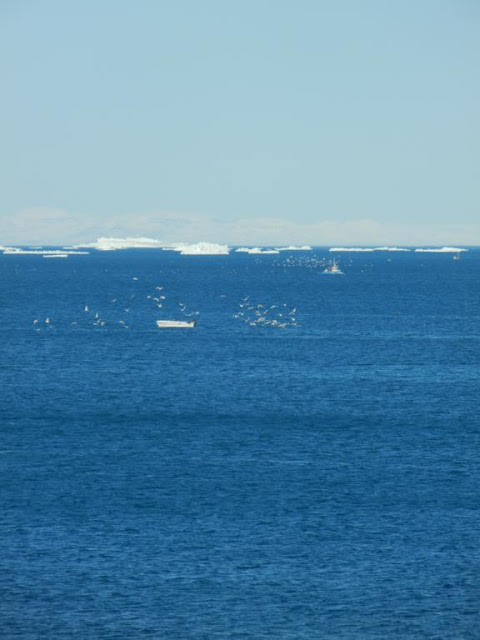
As my hotel room faced Disko Bay, each morning at around 8:15 - 8:30 am -- "Rush Hour", I would see dozens of small older looking aluminum fishing boats zoom across the bay towards the Icefjord. Apparently fish like to gather around and under the ice. The fishermen knew the dangers of being so close to icebergs as well as the signs when one was going to calve.
It's not an easy life there. This is still a culture of the One Man, One Boat for fishing and seal hunting with the goal of feeding their families. You can tell when a fish was caught by the number of sea birds that would suddenly come out of nowhere to follow the boats back into the harbour.
Interesting as well, I did not see one PFD on the fishermen and when I spent time on the water, there were no talks about safety nor did any of us wear one either. Maybe it was because we wouldn't have much hope anyways should we fall into such cold water.
You could hear a pin drop during the moments when one of our captains decided to plow through some solid flats of ice to get to the other side...
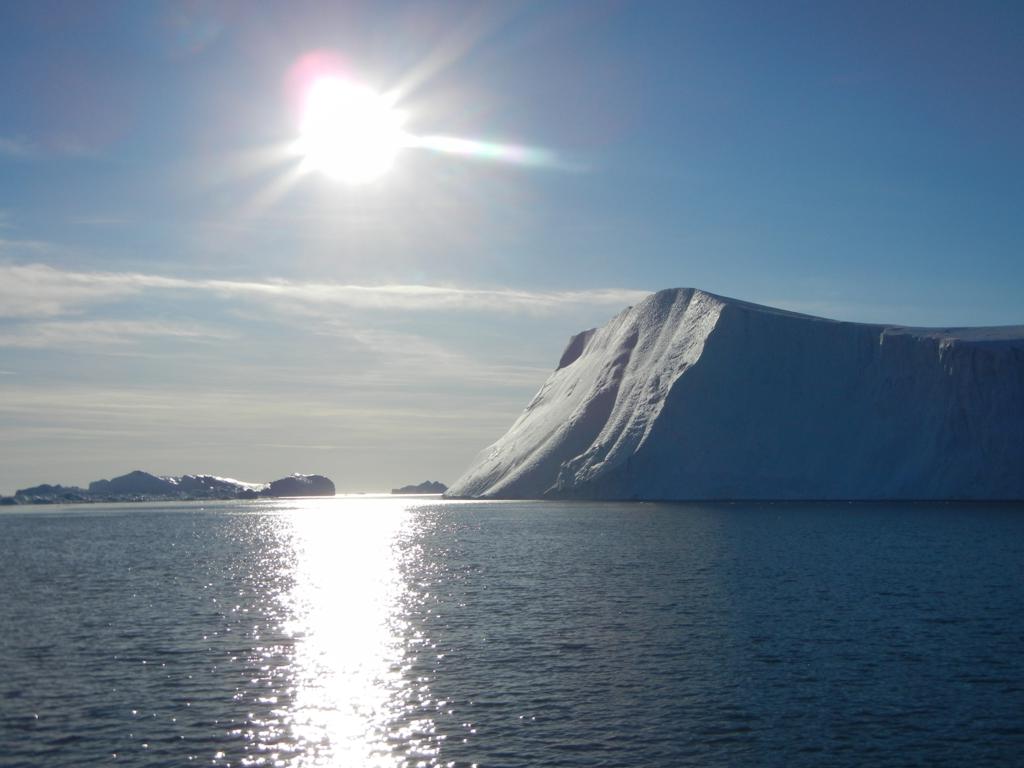
The Icefjord changes constantly. Some of the giant icebergs extend 1400 m below what towered over us. We see only 1/7 - 1/10th of its total size. And the ice field extends about 67 km upstream from the mouth of the fjord, solidly packed with ice and icebergs. The clarity of the ice, the absence or presence of bubbles all help to indicate its age.
On our last afternoon out on the water, a small chunk of ice was captured so we could all enjoy a Martini on the rocks, out in the middle of the Icefjord, surrounded by silence and the setting sun. An artificial moment amongst the harsh reality all around us, I realized, but for the half an hour we were anchored, it felt peaceful.
You can tell who the tourists were by who needed to wear sunglasses to shield against the wind and brightness. And by who still needed the heavier coats and clothing during the warm spell. Parents were teaching their toddlers, dressed in full snow suits, how to ride bicycles (training wheels) on the ice laden sides of the roads. People had windows open at their homes. You could hear teenagers belting out the tunes. Everyone was taking advantage of the unseasonable weather.
Normally I would make an effort to speak the local language but even with my cheat sheet, I could not remember or get out of my mouth quickly enough much other than hello in Greenlandic. And you can never tell if someone is going to speak to you in Danish (mine was non existent). Kids are brought up with both languages.
As my hotel room faced Disko Bay, each morning at around 8:15 - 8:30 am -- "Rush Hour", I would see dozens of small older looking aluminum fishing boats zoom across the bay towards the Icefjord. Apparently fish like to gather around and under the ice. The fishermen knew the dangers of being so close to icebergs as well as the signs when one was going to calve.
It's not an easy life there. This is still a culture of the One Man, One Boat for fishing and seal hunting with the goal of feeding their families. You can tell when a fish was caught by the number of sea birds that would suddenly come out of nowhere to follow the boats back into the harbour.
Interesting as well, I did not see one PFD on the fishermen and when I spent time on the water, there were no talks about safety nor did any of us wear one either. Maybe it was because we wouldn't have much hope anyways should we fall into such cold water.
You could hear a pin drop during the moments when one of our captains decided to plow through some solid flats of ice to get to the other side...
The Icefjord changes constantly. Some of the giant icebergs extend 1400 m below what towered over us. We see only 1/7 - 1/10th of its total size. And the ice field extends about 67 km upstream from the mouth of the fjord, solidly packed with ice and icebergs. The clarity of the ice, the absence or presence of bubbles all help to indicate its age.
On our last afternoon out on the water, a small chunk of ice was captured so we could all enjoy a Martini on the rocks, out in the middle of the Icefjord, surrounded by silence and the setting sun. An artificial moment amongst the harsh reality all around us, I realized, but for the half an hour we were anchored, it felt peaceful.

Sunday, April 14, 2013
Why Go?
If you have been wondering if the reason I went to Greenland was just to see the ice fjord and northern lights, the answer is yes. Those were reasons 2 and 3, but the primary one was to go on a dog sled excursion in a country where it is still the dominant and preferred mode of transport between villages. You gotta love a place that is otherwise only accessible by boat, plane or helicopter. Snowmobiles are not allowed here.
So why haven't I showed any pictures of my excursion? Because it was cancelled. For a month before my arrival I had been tracking the weather. When we came home from skiing, I had brought back my ski pants and base layers in anticipation of Greenland. It was going to be a game time decision, the final packing list, all dependent on weather. Iceland was going to be down right warm in comparison.
Average temperatures in Ilulissat had been cold, -25 to 35 C. In preparation I tried on a number of different layering combinations to make sure I could still move my arms and squat because dog sledding is more active than you think. You're not going to be just sitting there. You will have to be ready to get off and push the sled. Plus if you noticed in my pictures, the sled is pretty primitive -- Read: Hard surface. So I expected a bit of jarring. You could rent seal skin clothing and boots if you do not have appropriate gear.
A week before, there was a massive heat wave, so large, it melted a lot of snow in Ilulissat and warped the dog sled trails to the point they weren't safe to be travelled on. You risked breaking your arm. I didn't find this out until I arrived to the tour office to pay for everything. You can imagine my disappointment.
Dog sled excursions run from Feb - Apr usually and the lot of us who came to do this were surprised at this turn of events. That's why the in town pictures didn't show a whole lot of snow. I was hoping everything would be stark white and windy with a portion of Disko Bay frozen, dotted with icebergs. A true winter wonderland, my vision of what I expected Greenland to look like.
Ilulissat is a pretty small town -- around 4000 people with just as many sled dogs. The town map has hatched areas showing you where the majority of dogs are kept (perimeter) with many private homes having a few of their own. You are not to approach them. They are working dogs, not pets. And are built to sleep outside in the extreme cold. They are often deadly silent.
A few times I'd be walking along the road (no sidewalks or sewers, so very slippery in the morning) and all of a sudden I'd feel like I was being watched. They never barked or charged at me but witnessing a whole rocky field of them can be intimidating. And I would have to admit, when a loose one ran right out from behind me in town, it did make me brace.
It was fun seeing them get all animated when their owners were in range, all jostling to be picked. At first sight, because I was projecting the North American pet culture, I felt sad seeing them all chained up sleeping on the ice. But upon careful observation, they give off a contented feeling.
Had my dog sled excursion went ahead, I would have had to learn to channel my alpha side as that is the only way you can get the dogs to respond to your commands. You also learn quickly to check the length of their chains as well as location of dog poop piles. Some chains will allow the dogs to reach the edge of the road where people are walking. I found it to be pretty obvious when you were approaching a sled dog area from the smell.
Because the town is small, you end up seeing the same people who flew on the plane with you at restaurants, hotels, shops and on various excursions. There are a number of tour outfits and if numbers are low, they group you together anyway. With all dog sledding out of the picture that week, people had to scramble to secure hotel accommodations for the nights they now had to spend in town as well as organize other things to do.
Because it was low season, (most people go to Greenland in the summer) there were pretty much only 4 restaurants/cafes open for food outside of hotel restaurants. Don't let that deter you because you can still eat very well. Their ice fjord halibut (poached and finished with sea salt and curry sprinkled on top) quickly became a favourite which surprised me because until now I only like my fish raw or deep fried.
Should you wish to cook, the main supermarket is fantastic. The seafood and wild game selection was incredible. You could literally buy a quarter of an animal. Fruits and vegetables were not the freshest but look where you are. For a town so small there were about a dozen smaller supermarkets too. The only explanation I could come up with was that the winters are so harsh, you don't want to have travel far to get food?
I encountered a minority of travellers who had this idea that the Greenlandic people were Eskimo. They are Inuit and in my observation, do not take kindly to being mistaken for Eskimo (Alaska and Canada). So don't go around hoping to see and take pictures of "Eskimo kisses" because you won't find any.

So why haven't I showed any pictures of my excursion? Because it was cancelled. For a month before my arrival I had been tracking the weather. When we came home from skiing, I had brought back my ski pants and base layers in anticipation of Greenland. It was going to be a game time decision, the final packing list, all dependent on weather. Iceland was going to be down right warm in comparison.
Average temperatures in Ilulissat had been cold, -25 to 35 C. In preparation I tried on a number of different layering combinations to make sure I could still move my arms and squat because dog sledding is more active than you think. You're not going to be just sitting there. You will have to be ready to get off and push the sled. Plus if you noticed in my pictures, the sled is pretty primitive -- Read: Hard surface. So I expected a bit of jarring. You could rent seal skin clothing and boots if you do not have appropriate gear.
A week before, there was a massive heat wave, so large, it melted a lot of snow in Ilulissat and warped the dog sled trails to the point they weren't safe to be travelled on. You risked breaking your arm. I didn't find this out until I arrived to the tour office to pay for everything. You can imagine my disappointment.
Dog sled excursions run from Feb - Apr usually and the lot of us who came to do this were surprised at this turn of events. That's why the in town pictures didn't show a whole lot of snow. I was hoping everything would be stark white and windy with a portion of Disko Bay frozen, dotted with icebergs. A true winter wonderland, my vision of what I expected Greenland to look like.
Ilulissat is a pretty small town -- around 4000 people with just as many sled dogs. The town map has hatched areas showing you where the majority of dogs are kept (perimeter) with many private homes having a few of their own. You are not to approach them. They are working dogs, not pets. And are built to sleep outside in the extreme cold. They are often deadly silent.
A few times I'd be walking along the road (no sidewalks or sewers, so very slippery in the morning) and all of a sudden I'd feel like I was being watched. They never barked or charged at me but witnessing a whole rocky field of them can be intimidating. And I would have to admit, when a loose one ran right out from behind me in town, it did make me brace.
It was fun seeing them get all animated when their owners were in range, all jostling to be picked. At first sight, because I was projecting the North American pet culture, I felt sad seeing them all chained up sleeping on the ice. But upon careful observation, they give off a contented feeling.
Had my dog sled excursion went ahead, I would have had to learn to channel my alpha side as that is the only way you can get the dogs to respond to your commands. You also learn quickly to check the length of their chains as well as location of dog poop piles. Some chains will allow the dogs to reach the edge of the road where people are walking. I found it to be pretty obvious when you were approaching a sled dog area from the smell.
Because the town is small, you end up seeing the same people who flew on the plane with you at restaurants, hotels, shops and on various excursions. There are a number of tour outfits and if numbers are low, they group you together anyway. With all dog sledding out of the picture that week, people had to scramble to secure hotel accommodations for the nights they now had to spend in town as well as organize other things to do.
Because it was low season, (most people go to Greenland in the summer) there were pretty much only 4 restaurants/cafes open for food outside of hotel restaurants. Don't let that deter you because you can still eat very well. Their ice fjord halibut (poached and finished with sea salt and curry sprinkled on top) quickly became a favourite which surprised me because until now I only like my fish raw or deep fried.
Should you wish to cook, the main supermarket is fantastic. The seafood and wild game selection was incredible. You could literally buy a quarter of an animal. Fruits and vegetables were not the freshest but look where you are. For a town so small there were about a dozen smaller supermarkets too. The only explanation I could come up with was that the winters are so harsh, you don't want to have travel far to get food?
I encountered a minority of travellers who had this idea that the Greenlandic people were Eskimo. They are Inuit and in my observation, do not take kindly to being mistaken for Eskimo (Alaska and Canada). So don't go around hoping to see and take pictures of "Eskimo kisses" because you won't find any.

Surprise to find this as part of my hotel room binder.
Obvious, no?
Thursday, April 11, 2013
Elements
S. B. made a comment earlier he thought my pictures seemed better this time around. When in reality D's camera has gotten more beaten up over the last couple of years. I'm being emotionally biased when I say I feel my best pictures are of Norway, with Cinque Terre second and this last set a close third.
As mentioned before, my background is with manual photography and I remember learning a bit about the various types of filters available to bring out certain elements.
What I noticed immediately in Greenland was the clarity of the night sky. I've never seen stars shine so sharply that their sparkles and flickers were as distinct as metal. And the amount of stars! I wish I had access to a telescope. Whereas in Iceland the daytime light had a clear gray tone to it even on a bright day. The nighttime sky in the city wasn't remarkable enough to stand out to me.
The glacial ice in Greenland had a tinge of blue or turquoise and sometimes gray blue. My thought is, when sunlight went through/reflected off of it, it acted like a lens filter, and our eyes took it in as clearer, sharper, brighter. As if a polarizing filter was used. Even a scratched up camera lens caught that. Should I return with a new camera, it would be interesting to compare picture quality.
Also the quality of the ice was something I've never encountered before (not counting cruising by). Glacial ice is really really hard. In Iceland we went to what remained of the glacier that was melted when Eyjafjallajokull erupted and our guide got us a piece to chomp on. We couldn't break into it and D is a veteran ice chewer.
In Ilulissat one morning I decided to walk to the mouth of the ice fjord and there were quite a few moments where I questioned my judgement. Crossing small areas of glacial ice melt was extremely slippery and treacherous. Once you got sliding, you just couldn't stop easily. I'm not sure sitting down would have helped much.
And trying to go back uphill...Scared me...No traction. I ended up leaving the trail and climbing over lichen covered rocks to go around. Should you find yourself in the same situation, watch your footing because there could be streams underneath the ice and always test your next step as moss may not be covering anything solid. Getting submerged thigh high and your ankle caught between rocks wouldn't be desirable. I saw a few scarily misplaced foot prints.
I had read that when camping in the winter, you need to screw down sleeping bags into the ice because if you get sliding, you may not stop until it is too late. Didn't understand what that really meant until I got on the ice. I didn't have my ice cleats with me as I was expecting snow and an "easy" walk but I would definitely remember them for next time. The less than 5 km took me 1 1/2 hours! I do question whether they would have been strong enough to penetrate the ice but won't really know until I try them out next time.
And the wind! You don't realize how surprising wind is when there are no sound indicators (no trees). In Greenland, you would just suddenly get slammed. I found I had to turn around to catch my breath because it was so strong. It was strong enough to physically stop me in my tracks. I now completely understand how wind and ultra slippery ice form a potentially deadly combination.
One other thing to remember -- Your cell phone (even a world one) will probably not work in Greenland. Hotels will offer you free use of theirs'. You just have to pay for air time. I forgot to get one. And had no whistle on me either. You can imagine I felt pretty silly when I found myself with no one around for hours and I wasn't even that far out. Or it could have been locals had more sense than to be where I was that morning.


As mentioned before, my background is with manual photography and I remember learning a bit about the various types of filters available to bring out certain elements.
What I noticed immediately in Greenland was the clarity of the night sky. I've never seen stars shine so sharply that their sparkles and flickers were as distinct as metal. And the amount of stars! I wish I had access to a telescope. Whereas in Iceland the daytime light had a clear gray tone to it even on a bright day. The nighttime sky in the city wasn't remarkable enough to stand out to me.
The glacial ice in Greenland had a tinge of blue or turquoise and sometimes gray blue. My thought is, when sunlight went through/reflected off of it, it acted like a lens filter, and our eyes took it in as clearer, sharper, brighter. As if a polarizing filter was used. Even a scratched up camera lens caught that. Should I return with a new camera, it would be interesting to compare picture quality.
Also the quality of the ice was something I've never encountered before (not counting cruising by). Glacial ice is really really hard. In Iceland we went to what remained of the glacier that was melted when Eyjafjallajokull erupted and our guide got us a piece to chomp on. We couldn't break into it and D is a veteran ice chewer.
In Ilulissat one morning I decided to walk to the mouth of the ice fjord and there were quite a few moments where I questioned my judgement. Crossing small areas of glacial ice melt was extremely slippery and treacherous. Once you got sliding, you just couldn't stop easily. I'm not sure sitting down would have helped much.
And trying to go back uphill...Scared me...No traction. I ended up leaving the trail and climbing over lichen covered rocks to go around. Should you find yourself in the same situation, watch your footing because there could be streams underneath the ice and always test your next step as moss may not be covering anything solid. Getting submerged thigh high and your ankle caught between rocks wouldn't be desirable. I saw a few scarily misplaced foot prints.
I had read that when camping in the winter, you need to screw down sleeping bags into the ice because if you get sliding, you may not stop until it is too late. Didn't understand what that really meant until I got on the ice. I didn't have my ice cleats with me as I was expecting snow and an "easy" walk but I would definitely remember them for next time. The less than 5 km took me 1 1/2 hours! I do question whether they would have been strong enough to penetrate the ice but won't really know until I try them out next time.
And the wind! You don't realize how surprising wind is when there are no sound indicators (no trees). In Greenland, you would just suddenly get slammed. I found I had to turn around to catch my breath because it was so strong. It was strong enough to physically stop me in my tracks. I now completely understand how wind and ultra slippery ice form a potentially deadly combination.
One other thing to remember -- Your cell phone (even a world one) will probably not work in Greenland. Hotels will offer you free use of theirs'. You just have to pay for air time. I forgot to get one. And had no whistle on me either. You can imagine I felt pretty silly when I found myself with no one around for hours and I wasn't even that far out. Or it could have been locals had more sense than to be where I was that morning.


Post Eyjafjallajokull eruption site.

Crossing this stuff was crazy!
Easily could have been blown into the water.
I remember standing here thinking, OMG do I keep going?!
Friday, April 5, 2013
Far Away Places
As you've likely gathered by the skewed number of pictures, the goal of this trip was for me to get to Ilulissat. Iceland was the cherry on top.
I was so happy D decided to come along (for the Iceland leg) as I got to experience his wonder and excitement in a new place. He's heard me go on and on about Iceland ever since I stepped foot on its soil 3 years ago, returning with a subscription to Iceland Review, despite falling off a horse and being pummeled by sleet the whole week.
Some people dream of Hawaii (Maybe a bad example as when I think of Hawaii now, I smile and think helicopters! But I think you know what I mean.). I dream of vast open places where conditions are extreme, harshly beautiful and the people (and animals) are tough and few and far between. Where silence out weights human sounds and where nature's sheer scale takes center stage.*
I want to go there to be visually and emotionally stunned. To learn to be stronger, to understand what skills one would need to survive there and what it would take to achieve the basic levels of Maslow's hierarchy. To see first hand how important it is to preserve our delicate world. To be reminded of what a truly "easy" life I have in Canada. To step out of my "self".
It's probably no surprise that the harshest areas on Earth are often the least accessible and most expensive to get to. It takes more planning and preparation than usual and you will need to build in leeway on either side in case of weather. Mother Nature does not take your need to get back to work on time into consideration. When there are only 2 flights a week in a fairly small plane and it is winter, you decide how much risk you're willing to take.
One reward is you get the pleasure of meeting some true adventurers. From the moment we walked into the small domestic airport in Reykjavik we were immersed into a world we've never witness before.
Dozens of people with plastic wrapped sleds, huge waterproof expedition sacks, large serious packs, dressed for extreme and fit fit fit. It was obviously there were a number of groups going on multi day/week treks. And gaging the energy coming from those people, if anything should happen, I'd want to be on their team. We were excited to be in their company.
One does not decide to go to Greenland by mistake. Expect to be thoroughly "checked out" visually. People were curious about what type of preparation others made. Judging from the language, the groups we encountered were from many difference countries around the world.
There were 2 flights leaving for the east and west coast of Greenland that morning versus many hourly flights within Iceland. The destined for Greenland people's gear took up 80% of the small airport's space. March and April are the prime months for dog sled and human expeditions. March is also the last month where you will be able to see the Aurora before the growing daylight gets too strong.
I finally saw the Northern Lights! Ironically stronger in Reykjavik than Ilulissat. They really are dynamic. I didn't know what to expect. I thought they would just show up and stay there. Instead they come in and out of view, sinking down and you can almost see particles. We witnessed mostly green and yellow with some blue/purple. You need to have a camera capable of 30 sec exposures to be able to capture them. I'm sure D's camera could but neither of us bothered to figure it out in advance.
The day I departed for Greenland (wouldn't you know it?), that evening, D saw such a magnificent display from our apartment (magazine beautiful -- we had access to a high deck), he actually got bored when it just went on and on, and thought he might have gotten sunburned from the strength of the lights...Meanwhile I'm standing there in Ilulissat at 2 am getting neck cramps from looking up and seeing (imagining?) small wisps of them and wondering what this over 95% chance of seeing them is all about!
*Until I have the time, energy and funds to get to such vastly harsh places, I will continue to explore the many other more populated parts of the world.

I was so happy D decided to come along (for the Iceland leg) as I got to experience his wonder and excitement in a new place. He's heard me go on and on about Iceland ever since I stepped foot on its soil 3 years ago, returning with a subscription to Iceland Review, despite falling off a horse and being pummeled by sleet the whole week.
Some people dream of Hawaii (Maybe a bad example as when I think of Hawaii now, I smile and think helicopters! But I think you know what I mean.). I dream of vast open places where conditions are extreme, harshly beautiful and the people (and animals) are tough and few and far between. Where silence out weights human sounds and where nature's sheer scale takes center stage.*
I want to go there to be visually and emotionally stunned. To learn to be stronger, to understand what skills one would need to survive there and what it would take to achieve the basic levels of Maslow's hierarchy. To see first hand how important it is to preserve our delicate world. To be reminded of what a truly "easy" life I have in Canada. To step out of my "self".
It's probably no surprise that the harshest areas on Earth are often the least accessible and most expensive to get to. It takes more planning and preparation than usual and you will need to build in leeway on either side in case of weather. Mother Nature does not take your need to get back to work on time into consideration. When there are only 2 flights a week in a fairly small plane and it is winter, you decide how much risk you're willing to take.
One reward is you get the pleasure of meeting some true adventurers. From the moment we walked into the small domestic airport in Reykjavik we were immersed into a world we've never witness before.
Dozens of people with plastic wrapped sleds, huge waterproof expedition sacks, large serious packs, dressed for extreme and fit fit fit. It was obviously there were a number of groups going on multi day/week treks. And gaging the energy coming from those people, if anything should happen, I'd want to be on their team. We were excited to be in their company.
One does not decide to go to Greenland by mistake. Expect to be thoroughly "checked out" visually. People were curious about what type of preparation others made. Judging from the language, the groups we encountered were from many difference countries around the world.
There were 2 flights leaving for the east and west coast of Greenland that morning versus many hourly flights within Iceland. The destined for Greenland people's gear took up 80% of the small airport's space. March and April are the prime months for dog sled and human expeditions. March is also the last month where you will be able to see the Aurora before the growing daylight gets too strong.
I finally saw the Northern Lights! Ironically stronger in Reykjavik than Ilulissat. They really are dynamic. I didn't know what to expect. I thought they would just show up and stay there. Instead they come in and out of view, sinking down and you can almost see particles. We witnessed mostly green and yellow with some blue/purple. You need to have a camera capable of 30 sec exposures to be able to capture them. I'm sure D's camera could but neither of us bothered to figure it out in advance.
The day I departed for Greenland (wouldn't you know it?), that evening, D saw such a magnificent display from our apartment (magazine beautiful -- we had access to a high deck), he actually got bored when it just went on and on, and thought he might have gotten sunburned from the strength of the lights...Meanwhile I'm standing there in Ilulissat at 2 am getting neck cramps from looking up and seeing (imagining?) small wisps of them and wondering what this over 95% chance of seeing them is all about!
*Until I have the time, energy and funds to get to such vastly harsh places, I will continue to explore the many other more populated parts of the world.

Wednesday, April 3, 2013
Views From the Water -- Late Afternoon


Can you see where the helipad is?


That's it for iceberg pictures.
It was hard choosing from the hundreds I took.
And I still haven't finished sorting the Iceland ones either.
D told me I set a new record this trip for number of travel photos.
Tuesday, April 2, 2013




Monday, April 1, 2013


Subscribe to:
Posts (Atom)